
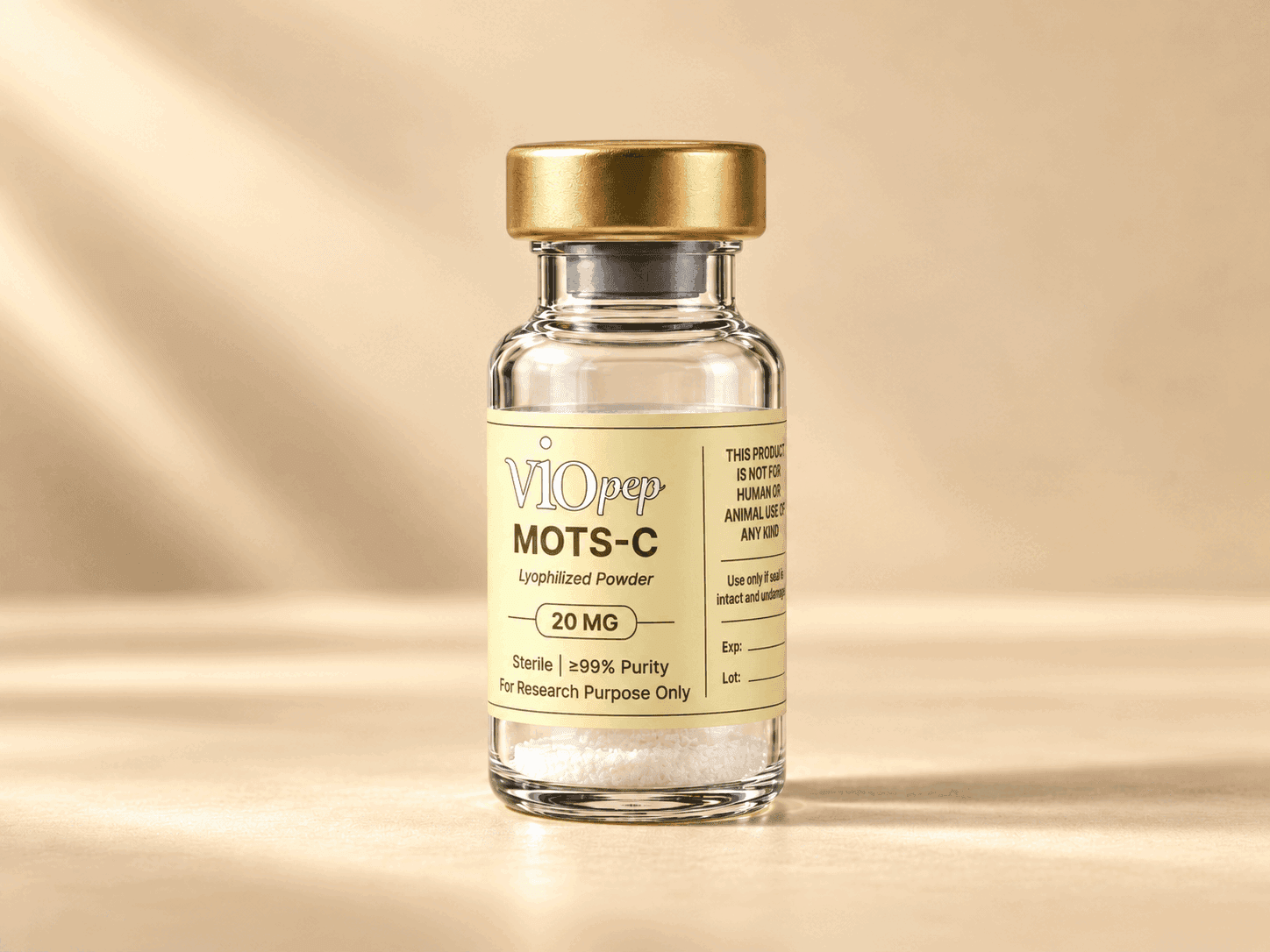
MOTS-c
Mitochondrial-Derived Peptide for Metabolic Homeostasis & Cellular Stress Research
- Third-party tested
- COA per batch
- Lyophilized research material
Description
MOTS-c is a 16-amino-acid mitochondrial-derived peptide encoded within the mitochondrial 12S rRNA region. It is investigated in cellular models involving metabolic homeostasis, mitochondrial signaling, AMPK-associated pathways, cellular stress responses, and metabolic adaptation.
$120.00/ 20 mg · USD
Volume pricing
Applied automatically in the cart
| Quantity | Per unit | You save |
|---|---|---|
| 3–4 units | $114.00 | −5% |
| 5–9 units | $108.00 | −10% |
| 10+ units | $102.00 | −15% |
Add 2 more to save 5% on every unit.
SKU VP-MOTS-20
Certificate published per batch
Awaiting client documentation
Purity stated per lot
Figures are reported against the lot they belong to, never as a brand average. The analysis for a batch is published on that batch’s certificate.
- Certificate published for each batch
- Third-party tested
- Orders over $200 ship free
- Supplied for laboratory research use only
Complete your protocol
Lyophilized vials are supplied dry. Add the accompanying laboratory supplies in one step.
- MOTS-cThis item
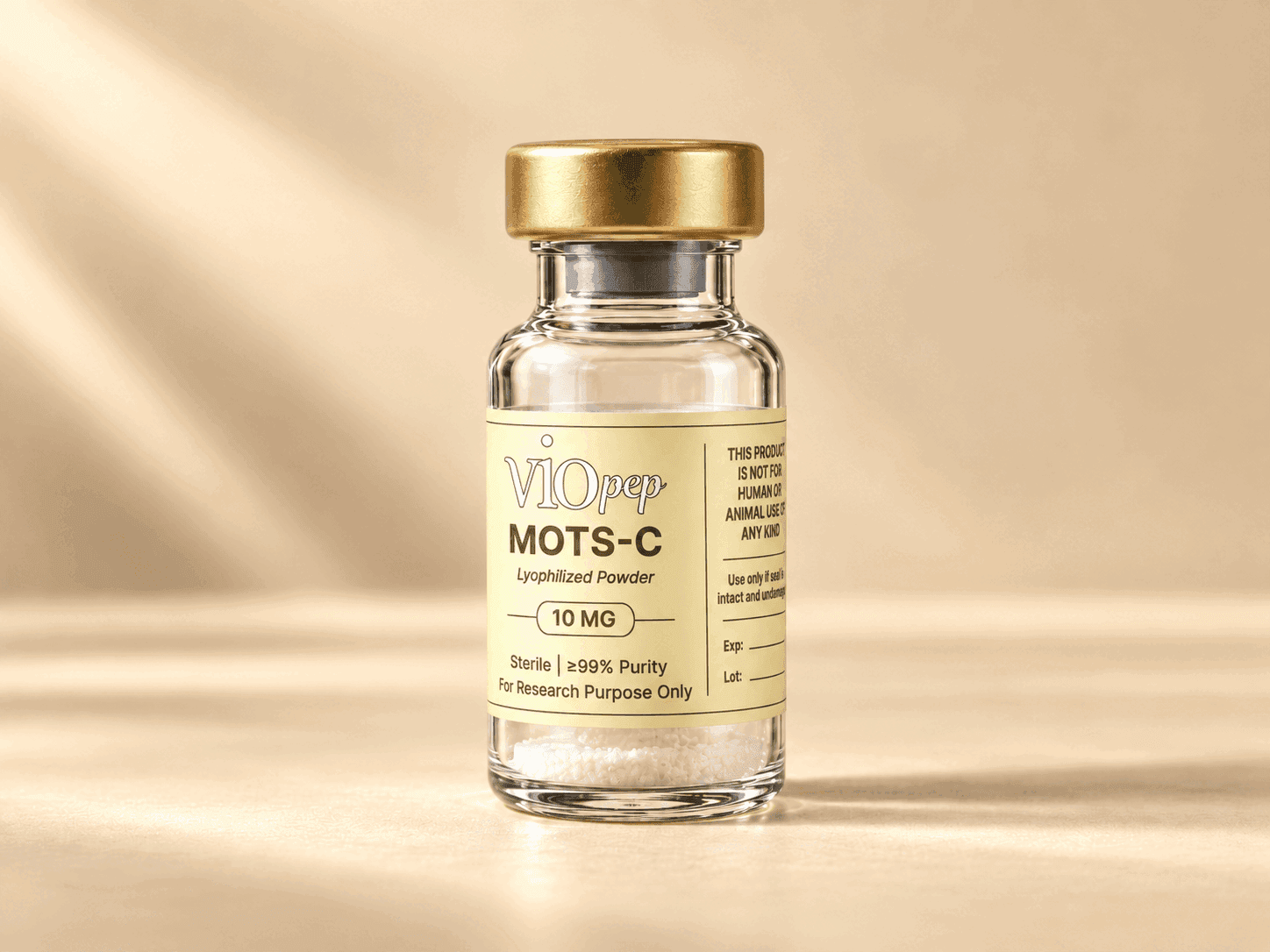
Nothing selected
$0.00
Supplied as laboratory materials for research use only.
Scientific overview
MOTS-c belongs to a relatively recently characterized group known as mitochondrial-derived peptides. Unlike traditional nuclear-encoded peptides, MOTS-c originates from a short open reading frame associated with mitochondrial DNA. Experimental work has identified relationships between MOTS-c signaling and cellular metabolic regulation. Research has examined interactions involving AMPK signaling, folate-cycle pathways, purine biosynthesis, cellular glucose metabolism, metabolic stress responses, and mitochondrial-to-nuclear communication. Under certain cellular stress conditions, research has also demonstrated translocation of MOTS-c to the nucleus, where it may participate in regulation of stress-responsive gene expression.
Research applications
- Mitochondrial signaling
- AMPK-associated pathways
- Metabolic homeostasis
- Cellular glucose metabolism
- Metabolic stress
- Mitochondrial-derived peptide biology
- Nuclear gene-expression responses
- Cellular adaptation
- Energy metabolism
- Mitochondrial communication
*Exact molecular weight depends upon the chemical/salt form represented by the applicable batch documentation.
Research use & regulatory disclaimer
All products offered by viopep are intended solely for laboratory research and analytical purposes. viopep products are not intended for human or veterinary use or consumption.
Products offered by viopep have not been approved by the U.S. Food and Drug Administration (FDA) for the diagnosis, treatment, cure, mitigation, or prevention of any disease or medical condition. Products are not intended to be used as drugs, food products, dietary supplements, cosmetics, or household products.
Information provided on this website is for general informational and research purposes only. Nothing on this website is intended to constitute medical advice, diagnosis, treatment recommendations, dosing instructions, or guidance regarding human or veterinary use.
By purchasing from viopep, the purchaser acknowledges that products are intended solely for legitimate research purposes and agrees to use and handle all products in accordance with applicable laws, regulations, and appropriate laboratory safety procedures.
Specifications
| Compound | MOTS-c |
|---|---|
| Full Name | Mitochondrial Open Reading Frame of the 12S rRNA-c |
| Peptide Length | 16 amino acids |
| CAS Number | 1627580-64-6 |
| Approximate Molecular Weight | 2174.6 g/mol* |
| Research Category | Mitochondrial & Metabolic Signaling |
| Catalog strengths | 10 mg / 20 mg / 40 mg |
| SKU | VP-MOTS-10 / VP-MOTS-20 / VP-MOTS-40 |
| Purity | Published on the certificate for each batch |
| Analytical method | Published on the certificate for each batch |
| Testing laboratory | Published on the certificate for each batch |
| Form | Lyophilized research material |
Storage and handling
Store lyophilized at -20°C; protect from light and moisture. Reconstitute with bacteriostatic water; refrigerate reconstituted solution at 2-8°C.